Vegan Organic Network
Events
Tour of Tolhurst Organic Farm

Film of the Tour of Tolhurst Organic Farm July 2020
View Trailer
Free registration via Eventbrite
Join Tolly and George Monbiot on their tour of Tolhurst Organic Farm.
A farm which sets itself apart.
Unlike many organic farms, it doesn’t use animal fertilisers, such as fish, blood or bone.
Yes, It’s a veganic farm.
A haven for wildlife.
Produces bumper crops year on year.
The most well researched farm in the UK.
Attracting visitors from around the world.
Join Tolly and George Monbiot Farming for a Future
On Thursday 3rd June 7pm LIVE ON YOUTUBE Link to be announced soon.
Veganic Gardeners Question Time 29th April 2021

Veganic Gardeners’ Question Time
TV presenter Luke Scott III will host an entertaining evening with some twenty-four carrot advice from Stephane Groleau of the Veganic Agriculture Network, online veganic growing teacher Meghan Kelly and vegan gardener Piers Warren.
Watch live on Facebook or Youtube
Thursday 29th April 7pm UK Time Zone 45 minutes.
Please send your gardening and farming questions questions to: events@veganorganic.net
The panel:
Luke Scott III: Award-Winning International Speaker, the TV Show Host, the Spiritual Mentor and most recently Luke the Husband. Best-Selling Author of Find Your Truth: Your Guide to Living a Connected Life Filled With Purpose. Luke is setting up a vegan eco village. http://www.lukescottofficial.com/luke-scott-iii/
Meghan Kelly:I learned veganic permaculture to become more self-sufficient while sticking to my vegan values. I constantly experiment with a hands-on DIY approach. I’ve practiced veganics for 10+ years in community gardens, concrete jungles and up in the hills. I run the Learn Veganic online course https://learnveganic.com/ and co-founded the Veganic Agriculture Network https://www.goveganic.net/.
Stephane Groleau: I love innovating and finding new ways to veganize anything and everything. I studied organic vegetable farming and visited veganic farms across Europe. I’m equally comfortable optimizing a tiny balcony or planting berry bushes in the countryside. I co-founded the Veganic Agriculture Network in 2008 https://www.goveganic.net/ and I teach gardening online at Learn Veganic https://learnveganic.com/.
Piers Warren: Conservationist, author and keen grower of organic fruit and vegetables. He is the founder of Wildeye – The International School of Wildlife Film-making. Writer of several books and co-author of The Vegan Cook and Gardener.
More about Piers https://www.pierswarren.co.uk/
The Vegan Cook & Gardener https://veganorganic.net/product/vegan-cook-and-gardener/
Veganic Gardeners’ Question Time hopes to inspire and bring new ideas to foragers, growers and gardeners alike.
Now more than ever it is vital that we engage with how our food is grown.
Tune into our show and become part of the growing revolution which can not only transform your garden plot but also change the way the world grows its food.
A Vegan Organic Network production.
Rethinking Food and Agriculture

Rethinking Food and Agriculture
We had a couple of technical hiccups with the Laila Kassam interview the other day so here is the edited version. https://www.youtube.com/watch?v=QeamkOT_Cyc
Tony Martin interviews Dr Laila Kassam (Animal Think Tank) about her new book Rethinking Food and Agriculture which she co-authored with Professor Amir Kassam (University of Reading).
The book highlights the urgent need to ‘rethink’ the food and agriculture system and highlights ‘new ways forward’, including alternative paradigms of agriculture, human nutrition and political economy that are more ethical, sustainable and just. Contributors include Robert Chambers, David Jenkins, Tony Juniper, Dr. Shireen Kassam, David Montgomery, Vandana Shiva and many others. It’s a wonderful contribution to the science and philosophy supporting the urgent need to transition to a non-violent vegan food system and restore a right relationship with ourselves, other species and nature.
There will be a question and answer session at the end of the show, please send your questions to events@veganorganic.net or you can ask your question on the night in the comments section on Facebook or youtube during the show.
Full book review.
Veganic Gardeners’ Question Time 30th March 2021

Veganic Gardeners’ Question Time
Vegan teacher Ruth Greenwood will host an entertaining evening with some twenty-four carrot advice from veganic farmer Peter Albrecht, permaculture teacher Aranya, wild food forager Jon Dale and the founder of Spiral Seed Graham Burnett.
The event will be streamed live on Facebook and Youtube.
Tuesday 30th March 7pm UK Time Zone 45 minutes.
Watch on Facebook
Watch on YouTube
Please send your gardening and farming questions questions to: events@veganorganic.net
The panel:
Ruth Greenwood: Ruth will be hosting the show. She is devoted to empowering children to give them the confidence to grow into the people they want to be, while simultaneously offering support to adults who would like to understand the little vegans in their life better.
Ruth’s book ‘I Don’t Wanna Eat Animals Anymore’ presents a glimmer of hope to vegan kids around the world showing them that they are not alone and, most importantly, they have so much more power than they realise to make much needed changes. https://beacons.page/vteacheruk
Peter Albrecht: Operates a micro farm growing veggies for seed for a seed firm called Nordfrö in Sweden. He also grows for his family and puts on events, for example: vegan farming classes, vegan permaculture and private events. They grow a large variety of vegetables and beans. They also do lectures to promote vegan agriculture. They have a large forest garden with perennial vegetables, fruit and berries, and teach forest garden design and host pupils studying agriculture, small scale farming and permaculture. They mainly use no-dig methods.
Find Peter on Instagram @vegantradgard and Facebook
Aranya: is a busy permaculture teacher, having taught over 90 two-week design courses since 2005. He’s author of the popular ‘Permaculture Design – a Step-by-Step Guide’ and launched an online course this summer based on the design process described in the book. He’s currently finishing a second book, about the application of systems thinking and patterns in permaculture design, due to be published in 2021. He’s been gardening for 35 years and is especially interesting in low-input systems like forest gardening and no-dig.
This is a link to his book page:
https://learnpermaculture.com/publications/design-guide
And the online course:
https://learnpermaculture.com/courses/online-design-course
Jon Dale: Jon forages for edible wild foods in the natural habitat where he lives in Cornwall. He runs a veganic project ‘Willow Way’, near Newquay, a place of education, teaching self sufficiency and veganic principles. To help heal the earth and help people to reduce their footprint. Also to help people become engaged with where their food comes from and how it is grown and also to reverse illness through this lifestyle.
Graham Burnett: An activist for social and environmental justice since leaving school in the late 1970s, Graham Burnett has taught permaculture workshops and courses for over 20 years. He founded Spiralseed in 2001, and is a regular contributor to publications as diverse as Positive News, The Sunday Times, Permaculture Magazine, Permaculture Activist, New Leaves, The Raven, Growing Green, Funky Raw, The Vegan and The Idler. He the author of The Vegan Book of Permaculture and Permaculture A Beginners Guide, and is currently writing ‘The Regenerative Allotment and Garden’ for Permanent Publications. https://spiralseed.co.uk/
Veganic Gardeners’ Question Time hopes to inspire and bring new ideas to foragers, growers and gardeners alike.
Now more than ever it is vital that we engage with how our food is grown.
Tune into our show and become part of the growing revolution which can not only transform your garden plot but also change the way the world grows its food.
A Vegan Organic Network production.
Saving Earth’s Wildlife Through a Radical Change
Dr Colleen Mcduling
Saving Earth’s Wildlife Through a Radical Change
Have you ever wondered what the ratios between wildlife and livestock were? Well, in 2018, three scientists did and they carried out some research to find out the answer. Yinon Bar-On, Rob Phillips, and Ron Milo from Israel and California estimated the biomass of all living things on the Earth. Now, biomass is the weight or mass of a living being. It was the first study of its kind and it gave some rather interesting and alarming results. Their research was published in a journal called The Proceedings of the National Academy of Science (PNAS). The research was so significant that it was summarized in The Guardian.
Of all life forms on Earth, comprising animals, plants, bacteria, fungi and viruses, they found that plants made up for 82% of all life on Earth. Bacteria came in second with only 13%. The remaining fraction of 5% comprised everything else including all animals fungi and viruses.
But what made this study so disturbing was the fact that of the mammals, 60% were livestock , 36% were humans, whilst only a mere 4% were wildlife. This is a huge disproportion between livestock and wildlife. These researchers revealed that of the birds, a staggering 70% were being raised as farm animals for food whilst only 30% were wild birds living freely outdoors.


The research also revealed that of all living things on Earth, humans made up for only 0.01%. And yet, since humans appeared on the Earth a few million years ago, they have been responsible for the extinction of a whopping 83% of all wildlife. This is a huge figure. The WWF estimates that 10,000 species go extinct every year. This figure represents both plants and animals, but it is still a massive number.
So, what exactly is driving all of this? Why are so many species becoming extinct? The answer, quite simply, is our lifestyles and the way we grow our food.
Vegans have been blamed for deforestation of vast swathes of land to grow soya. But the actual truth, according to Greenpeace, is that 80% of all soya grown is fed to farmed animals, most of whom are in factory farms. Only about 6% of all soya ends up on our plates. Deforestation leads to animals losing their natural homes, their food sources and their protection. Invariably, this will lead to many, many species dying out. There is nothing to sustain them. Deforestation is carried out not only to grow soya (and also corn which is fed to livestock), but also for mining, logging, urban development and building of roads and railways.
It’s estimated that around 80 Billion land-based animals are killed to feed a burgeoning human population every year. And, until their untimely death, they need feeding! So, you can imagine how much land is used to grow food for them! This land that could be used to grow healthy plant-based food to feed humans. In some countries of the world, global poverty and hunger is rife.
A plant-based diet is highly recommended; it uses up a lot less land to grow enough food for human consumption. Wildlife is thus supported and the threat of extinction of species is greatly reduced.
It’s not only our dietary preferences that need addressing; it’s also agricultural systems as a whole. Growing crops responsibly and veganically supports the emergence of a myriad of both plant and animal species in the surrounding areas. Veganic growing does not use any animal-based fertilizers, any animal manures or any agrochemicals at all. Ecosystems are healthy and biodiversity is given the chance to thrive.
It has generally been accepted that the Earth is experiencing the Sixth Mass Extinction Event. Global ecosystems have become unstable and wildlife is disappearing at an exponential rate. In order to prevent any further biodiversity and wildlife loss, organizations such as the United Nations Environmental Program (UNEP) are strongly advocating a move to a plant-based diet, rewilding of Nature and eco-friendly agricultural systems.
The evidence is there. There needs to be a radical change in mindset. Humans need to go vegan and we need to reform our agricultural systems. And the sooner this is done, the more chance we have in preventing any further wildlife loss.
References:
Bar-On, Yinon M., Phillips, Rob and Milo, Ron; 2018; The biomass distribution on Earth; Proceedings of the National Academy of Sciences; 115 (25); 6506-6511; https://doi.org/10.1073/pnas.1711842115
Humans just 0.01% of all life but have destroyed 83% of wild mammals – study; The Guardian; https://www.theguardian.com/environment/2018/may/21/human-race-just-001-of-all-life-but-has-destroyed-over-80-of-wild-mammals-study
Deforestation and food: your questions answered; WWF; https://www.wwf.org.uk/food/deforestation-and-food-your-questions-answered
Are vegans and vegetarians destroying the planet?; Greenpeace Video; https://www.greenpeace.org.uk/news/soya-meat-vegetarian-vegan/
Food System Impacts on Biodiversity Loss: Three levers for food system transformation in support of nature; Chatham House Report, February 03, 2021; ISBN: 978 1 78413 433 4; https://www.chathamhouse.org/2021/02/food-system-impacts-biodiversity-loss
Veganic Agriculture and Vegan Lifestyles: Restoring the Balance on Earth
By Colleen McDuling
February 09, 2021

Extinction Rebellion, Climate Emergency, Global Warming, Animal Rebellion, Deforestation, Greta Thunberg, the Sixth Mass Extinction, the age of the Anthropocene, Global Hunger and COVID-19. These have all become household conversation points and terms within the last few years. COVID-19 and its causative agent, SARS-CoV-2, have dominated much of our media causing a great deal of panic and deaths world wide. Comparatively little thought has been given to our agricultural systems and the impact these have on biodiversity and the wildlife who enrich our planet.
In a groundbreaking study carried out in 2018 by Bar-On, Phillips and Milo, and published in the Proceedings of the National Academy of Sciences (PNAS),[1] the authors found that of all living things on Earth (including plants, bacteria, fungi and viruses), humans comprised only a mere 0.01%. The study was summarized in The Guardian which revealed that notwithstanding this small fraction, humans have been responsible for the extinction of 83% of all wild animals.[2] Moreover, the balance between domestic and wild animals was stark. Of the mammals, over 60% were livestock whilst only a mere 4% were wildlife. This disproportion was similarly noted in the birds; 70% were being raised as food animals whilst only 30% were wild birds.
Today, the situation is not much better. If anything it has gotten worse. Extinction of both plant and animal species, is occurring at an unprecedented rate. In 2019, the United Nations estimated that around 1 million species face extinction within the next few decades.[3] The WWF puts it very succinctly. It’s estimated that the extinction rate is 0.01% per year. This equates to around 10,000 species which go extinct every year.[4] This represents a rate between 1,000 and 10,000 times higher than the natural extinction rate. John R. Platt in The Revelator writes that dozens and dozens of species were declared extinct in 2020, including orchids, frogs and fish.[5]
No matter what the source, all agree that humans are to blame for this mass extinction event. But what exactly is driving all of this? The answer, quite simply, is our lifestyles together with our agricultural systems.
Soya production has been widely accused for vast swathes of life-giving forests being cut down. But the WWF reveals that 80% of soya is fed to livestock; mainly chickens, pigs and farmed salmon.[6] Greenpeace goes even further in saying that 90% is fed to livestock and the remaining 10% is divided up into two fractions; 6% for human consumption and 4% for industrial use.[7] Going back to the 2018 study and looking at the ratios of livestock to wild animals, it is clear that enormous amounts of soya are thus required. Most livestock are raised in factory farms. Deforestation disrupts ecosystems, kills wildlife and totally upsets the delicate balance of our Earth. It makes perfect sense, therefore, for humans to move to a plant-based diet without delay.
Deforestation and the resulting soya production is only a tiny aspect of how biodiversity is being compromised. Our agricultural systems are another. The soya mentioned ends up in soil as fertilizers. Animals consume the soya, and when they are processed for meat, their blood, bones and other body parts become ingredients for commercially produced fertilizers. Fertilizers, together with agrochemicals and manures, poison the soil and the crop.
Veganic crop production does not use fertilizers of any sort. The soil and crops are healthy and this, in turn, promotes the emergence of a myriad of animal and plant species in the surrounding areas. Veganic agriculture also does not use toxic agrochemicals, thereby protecting invertebrates, small vertebrates and plant species. Killing off so-called “pests”, either plant or animal, can and does have a knock-on effect. Many invertebrates are prey species for higher order animals who, without them as a source of food, will themselves starve and die. This goes up the entire food chain.
On February 03, 2021, Chatham House, an independent international affairs think tank, together with Compassion in World Farming and the United Nations.
Environmental Program (UNEP) released a comprehensive report during a live webinar detailing the impact global food systems have on biodiversity loss.[1] It comes as no surprise that the experts which included Dr. Jane Goodall, outlined three key fundamentals to protecting biodiversity: (1) A total human dietary shift to a plant-based diet, (2) Protecting and setting land aside for Nature, and (3) Farming in a more nature-friendly manner that will support biodiversity and not destroy it. The report was of such an important nature that it was summarised in most of the major UK national press including The Guardian, The Independent and the Daily Mail.
Without a total mindset change regarding our lifestyles and agricultural systems, biodiversity has no chance at recovery and the sixth mass extinction event will continue relentlessly. Once humans have adopted a plant-based lifestyle, respecting all life forms, and once agricultural systems become revolutionized with a move away from the use of agrochemicals, fertilizers and animal manures, then and only then will our biodiversity have a chance at recovering. And that will be a good first step in the right direction in restoring the balance on Earth.

All photographs copyright © Colleen McDuling.
[1] Food System Impacts on Biodiversity Loss: Three levers for food system transformation in support of nature; Chatham House Report, February 03, 2021; ISBN: 978 1 78413 433 4; https://www.chathamhouse.org/2021/02/food-system-impacts-biodiversity-loss
Also see report from CiWF at: https://www.ciwf.org.uk/news/2021/02/new-report-food-system-impacts-on-biodiversity-loss where a video of the event may be viewed
[1] Bar-On, Yinon M., Phillips, Rob and Milo, Ron; 2018; The biomass distribution on Earth; Proceedings of the National Academy of Sciences; 115 (25); 6506-6511; https://doi.org/10.1073/pnas.1711842115
[2] Humans just 0.01% of all life but have destroyed 83% of wild mammals – study; The Guardian; https://www.theguardian.com/environment/2018/may/21/human-race-just-001-of-all-life-but-has-destroyed-over-80-of-wild-mammals-study
[3] UN Report: Nature’s Dangerous Decline ‘Unprecedented’; Species Extinction Rates ‘Accelerating’; https://www.un.org/sustainabledevelopment/blog/2019/05/nature-decline-unprecedented-report/
[4] Well… this is the million dollar question. And one that’s very hard to answer. WWF; https://wwf.panda.org/discover/our_focus/biodiversity/biodiversity/
[5] What We’ve Lost: The Species Declared Extinct in 2020; January 6, 2021; Originally published in The Revelator and reposted in EcoWatch; https://www.ecowatch.com/species-extinct-in-2020-2649768697.html?rebelltitem=6#rebelltitem6
[6] Deforestation and food: your questions answered; WWF; https://www.wwf.org.uk/food/deforestation-and-food-your-questions-answered
[7] Are vegans and vegetarians destroying the planet?; Greenpeace Video; https://www.greenpeace.org.uk/news/soya-meat-vegetarian-vegan/
Veganic Gardeners’ Question Time 23rd February

Veganic Gardeners’ Question Time
Wellbeing Activist Evie Ve will host an entertaining evening with some twenty-four carrot advice from date farmer Jamie Jones, permaculture teacher Aranya and veganic grower Piers Warren.
Tuesday 23rd February 7pm UK Time Zone 45 minutes
Watch on Facebook or Youtube.
Please send your questions to: events@veganorganic.net
Evie V: Spiritual and Wellbeing Vegan Activist and founder of the Being Conscious Podcast.
Jamie Jones, Date Farmer California: When I first began picking fruit for a living, I never dreamed I would actually own and operate a farm myself, but through persistent hard work, a love for what I was doing, and a little luck, within just a few years, this somehow came to be, almost on its own. Around the turn of the new millennium, when the raw-vegan diet began to grow in popularity, we began selling the majority of our crop directly to the raw/vegan food community via mail order. This is how my life in agriculture began over 30 years ago, and the way it has unfolded so far. http://datepeople.net/
Piers Warren: Conservationist, author and keen grower of organic fruit and vegetables. He is the founder of Wildeye – The International School of Wildlife Film-making. Writer of several books and co-author of The Vegan Cook and Gardener.
More about Piers https://www.pierswarren.co.uk/veganic/
The Vegan Cook & Gardener https://veganorganic.net/product/vegan-cook-and-gardener/
Aranya: is a busy permaculture teacher, having taught over 90 two-week design courses since 2005. He’s author of the popular ‘Permaculture Design – a Step-by-Step Guide’ and launched an online course this summer based on the design process described in the book. He’s currently finishing a second book, about the application of systems thinking and patterns in permaculture design, due to be published in 2021. He’s been gardening for 35 years and is especially interesting in low-input systems like forest gardening and no-dig.
This is a link to his book page:
https://learnpermaculture.com/publications/design-guide
And the online course:
https://learnpermaculture.com/courses/online-design-course
Veganic Gardeners’ Question Time hopes to inspire and bring new ideas to foragers, growers and gardeners alike.
Now more than ever it is vital that we engage with how our food is grown.
Tune into our show and become part of the growing revolution which can not only transform your garden plot but also change the way the world grows its food.
A Vegan Organic Network production.
Save our Wildlife Video Competition

Short Video Competition
First prize: £500 | 2nd prize: £300 | 3rd Prize: £200

Make a video and be part of our social media campaign targeting the public and delegates attending COP26 the UN Climate Change Conference being held in Glasgow this November.
All videos will be entered into the draw for 3rd prize of £200.00. The best two videos will be awarded 1st and 2nd prize.
Be as creative as you like, videos must be 60 seconds or under. Submit as many entries as you like, we want to spread the message that there is a ‘Wildlife Emergency’.
Our film competition aims to spread the message that:
To Save our Wildlife we must move to a Plant Based Food System.
Of all mammals on Earth, ONLY 4% are WILDLIFE, 60% are farm animals and 36% are humans.
By adopting a plant-based food system, land used by farm animals can be converted to wildlife habitats.
- 80 percent of the world’s agricultural land is used for farming animals (livestock farming).
- When we remove the farm animals from our food chain, corn and soya fields required for animal feed can be transformed into nature reserves.
- World agriculture must move towards “people nourished per hectare”.
- Veganic agriculture is green, clean and cruelty free, it uses less land, water and fossil fuel resources than farm animal (livestock) dependent systems and creates a wildlife friendly environment where nature can thrive.
Read: Saving Earth Wildlife through Radical Change
Make a short film and help spread this urgent message to your friends, family, community and to politicians around the world.
Support VON’s Giant Vegan Trike TV at COP26

How to enter Save our Wildlife Video Competition:
- Make a short video 60 seconds or under, which communicates that: To Save our Wildlife we must move to a Plant Based Food System.
- Your video can be reportage, documentary, narrative (scripted) as well as an animation or a song or dance. There are no limits to your creativity, you can even submit multiple entries to the competition, spread your wings!
- Top entries will be posted on our website and social media channels so the public can support their favourite idea. This will be taken into account when the judges choose the winners.
- Closing date extended from 31st October until midnight 1st November 2021.
- Read article below: Saving Earths Wildlife Through Radical Change.
- Watch Time is Running Out
- Be creative, share your video, get the message out and be the difference.
- Winners to be announced in Vegan Organic Network Newsletter November 2021.
- Competition open to all ages and nationalities.
How to send in your entry:
Email a copy of your video to events@veganorganic.net.
Post and share your video on all your social media platforms.
- Facebook: Like and follow Vegan Organic Network Facebook page (https://www.facebook.com/VeganOrganicNetwork)
- Instagram: Follow Vegan Organic Network Instagram (@veganorganic.net), upload video to your Instagram account and tag #veganorganicuk and other tags about wildlife, sustainable living, farming and being vegan. Set your account to public, so we can see your video!
- Youtube: Upload your video send link to events@veganorganic.net and share on your email and social media platforms.
Tag your friends and tell them to enter too!
For further information contact: events@veganorganic.net
Saving Earth’s Wildlife Through a Radical Change
Have you ever wondered what the ratios between wildlife and livestock were? Well, in 2018, three scientists did and they carried out some research to find out the answer. Yinon Bar-On, Rob Phillips, and Ron Milo from Israel and California estimated the biomass of all living things on the Earth. Now, biomass is the weight or mass of a living being. It was the first study of its kind and it gave some rather interesting and alarming results. Their research was published in a journal called The Proceedings of the National Academy of Science (PNAS). The research was so significant that it was summarized in The Guardian.
Of all life forms on Earth, comprising animals, plants, bacteria, fungi and viruses, they found that plants made up for 82% of all life on Earth. Bacteria came in second with only 13%. The remaining fraction of 5% comprised everything else including all animals fungi and viruses.
But what made this study so disturbing was the fact that of the mammals, 60% were livestock , 36% were humans, whilst only a mere 4% were wildlife. This is a huge disproportion between livestock and wildlife. These researchers revealed that of the birds, a staggering 70% were being raised as farm animals for food whilst only 30% were wild birds living freely outdoors.
The research also revealed that of all living things on Earth, humans made up for only 0.01%. And yet, since humans appeared on the Earth a few million years ago, they have been responsible for the extinction of a whopping 83% of all wildlife. This is a huge figure. The WWF estimates that 10,000 species go extinct every year. This figure represents both plants and animals, but it is still a massive number.
So, what exactly is driving all of this? Why are so many species becoming extinct? The answer, quite simply, is our lifestyles and the way we grow our food.
Vegans have been blamed for deforestation of vast swathes of land to grow soya. But the actual truth, according to Greenpeace, is that 80% of all soya grown is fed to farmed animals, most of whom are in factory farms. Only about 6% of all soya ends up on our plates. Deforestation leads to animals losing their natural homes, their food sources and their protection. Invariably, this will lead to many, many species dying out. There is nothing to sustain them. Deforestation is carried out not only to grow soya (and also corn which is fed to livestock), but also for mining, logging, urban development and building of roads and railways.
It’s estimated that around 80 Billion land-based animals are killed to feed a burgeoning human population every year. And, until their untimely death, they need feeding! So, you can imagine how much land is used to grow food for them! This land that could be used to grow healthy plant-based food to feed humans. In some countries of the world, global poverty and hunger is rife.
A plant-based diet is highly recommended; it uses up a lot less land to grow enough food for human consumption. Wildlife is thus supported and the threat of extinction of species is greatly reduced.
It’s not only our dietary preferences that need addressing; it’s also agricultural systems as a whole. Growing crops responsibly and veganically supports the emergence of a myriad of both plant and animal species in the surrounding areas. Veganic growing does not use any animal-based fertilizers, any animal manures or any agrochemicals at all. Ecosystems are healthy and biodiversity is given the chance to thrive.
It has generally been accepted that the Earth is experiencing the Sixth Mass Extinction Event. Global ecosystems have become unstable and wildlife is disappearing at an exponential rate. In order to prevent any further biodiversity and wildlife loss, organizations such as the United Nations Environmental Program (UNEP) are strongly advocating a move to a plant-based diet, rewilding of Nature and eco-friendly agricultural systems.
The evidence is there. There needs to be a radical change in mindset. Humans need to go vegan and we need to reform our agricultural systems. And the sooner this is done, the more chance we have in preventing any further wildlife loss.
References:
Bar-On, Yinon M., Phillips, Rob and Milo, Ron; 2018; The biomass distribution on Earth; Proceedings of the National Academy of Sciences; 115 (25); 6506-6511; https://doi.org/10.1073/pnas.1711842115
Humans just 0.01% of all life but have destroyed 83% of wild mammals – study; The Guardian; https://www.theguardian.com/environment/2018/may/21/human-race-just-001-of-all-life-but-has-destroyed-over-80-of-wild-mammals-study
Deforestation and food: your questions answered; WWF; https://www.wwf.org.uk/food/deforestation-and-food-your-questions-answered
Are vegans and vegetarians destroying the planet?; Greenpeace Video; https://www.greenpeace.org.uk/news/soya-meat-vegetarian-vegan/
Food System Impacts on Biodiversity Loss: Three levers for food system transformation in support of nature; Chatham House Report, February 03, 2021; ISBN: 978 1 78413 433 4; https://www.chathamhouse.org/2021/02/food-system-impacts-biodiversity-loss
Veganic Gardeners’ Question Time 21st January 2021
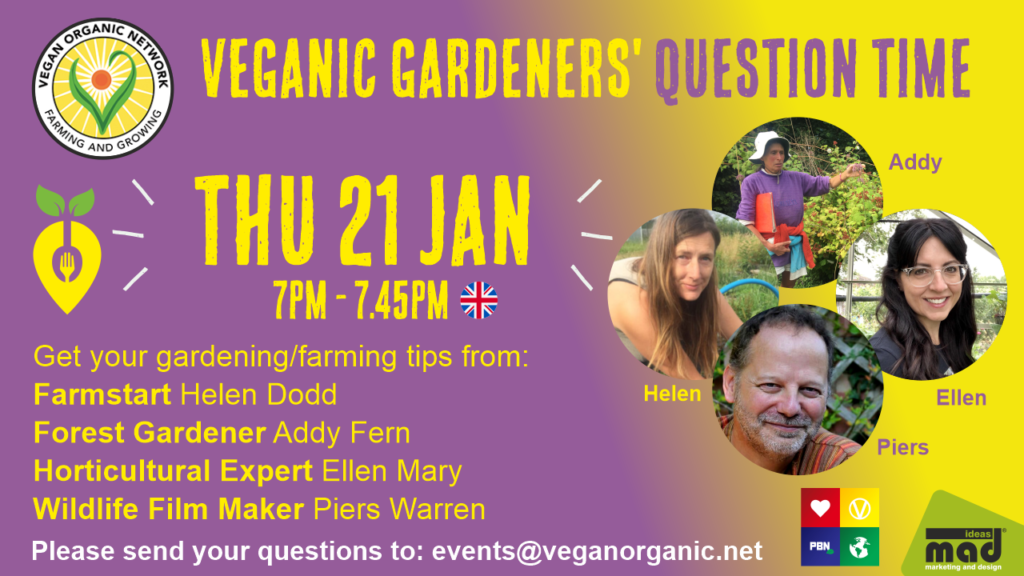
Horticultural expert Ellen-Mary will host an entertaining evening with twenty-four carrot advice from Forest Gardener Addy Fern, Farmstart Co-ordinator Helen Dodd and Wildlife film maker Piers Warren.
Thursday 21st January 7pm UK Time Zone 45 minutes
Streaming Live on FaceBook and YouTube.
Please send your questions to: events@veganorganic.net
The panel:
Ellen Mary: Horticultural radio show host, TV presenter, writer and of course vegan. She has travelled all over the world to discuss the benefits that nature provides to our wellbeing – specifically gardening.
Helen Dodd FarmStart Co-ordinator
As FarmStart Coordinator, Helen works with aspiring organic growers at Woodbank’s FarmStart veganic site, supporting them to develop the many skills needed to become competent and able growers.
Helen is passionate about food growing and creating environments that inspire and support positive learning experiences. She has over 20 years’ of growing experience, gained through juggling a myriad of roles; from running courses and training, setting up community growing spaces with The Federation of City Farms and Gardens and managing an Eco Centre.
Want to become a veganic farmer-contact: https://kindling.org.uk/FarmStart
Addy Fern Forest Gardener
Addy runs Plants for a Future a 28 acre forest garden in Cornwall:
- Perennial salad plants supplying fresh nutritious salads throughout the year.
- Fruiting trees and shrubs. In addition to the conventional fruit crops, we also grow many unusual and delicious fruits which allow us to eat fresh fruit all year round. Some of these fruits are also highly nutritious superfoods, such as Hippophae and Elaeagnus.
- Various protein, carbohydrate and oil-rich seed and root crops.
- A wide range of medicinal plants, many of which are also foods.
- Other useful plants, supply various useful commodities such as soaps, fibres and fuel.
- Lots of native plants, especially trees and shrubs, to provide a wild-life haven for the benefit of humans as well as the environment. About half the land was planted to native woodland in the early 1990’s.
For more information about the project visit: http://plantsforafuture.theferns.info/
Piers Warren: Conservationist, author and keen grower of organic fruit and vegetables. He is the founder of Wildeye – The International School of Wildlife Film-making. Writer of several books and co-author of The Vegan Cook and Gardener.
Piers Warren website The Vegan Cook & Gardener
Veganic Gardeners’ Question Time hopes to inspire and bring new ideas to foragers, growers and gardeners alike.
Now more than ever it is vital that we engage with how our food is grown.
Tune into our show and become part of the growing revolution which can not only transform your garden plot but also change the way the world grows its food.
A Vegan Organic Network production.
Veganic Gardeners’ Question Time 10th Dec 2020

Veganic Gardeners’ Question Time
Horticultural expert Ellen-Mary will host an entertaining evening with some twenty-four carrot advice from permaculture teacher Aranya, no dig gardener Steph Hafferty, and wild life film maker Piers Warren
Thursday 10th December 7pm UK Time Zone 45 minutes
Streaming Live on FaceBook and YouTube.
Please send your questions to: events@veganorganic.net
Ellen Mary: Horticultural radio show host, TV presenter, writer and of course vegan. She has travelled all over the world to discuss the benefits that nature provides to our wellbeing – specifically gardening.
Piers Warren: Conservationist, author and keen grower of organic fruit and vegetables. He is the founder of Wildeye – The International School of Wildlife Film-making. Writer of several books and co-author of The Vegan Cook and Gardener.
More about Piers https://wildeye.co.uk/piers-warren/The Vegan Cook & Gardener https://veganorganic.net/product/vegan-cook-and-gardener/
Steph Hafferty: Is a leading authority on no dig gardening, a garden and food writer, edible garden consultant, has worked as a no dig kitchen gardener for eleven years and grown on allotments for over 30 years.
Stephanie writes a blog, for various publications including a regular feature for Growing Green International, Permaculture magazine and the Kitchen Garden magazine and has written three books including:
The Creative Kitchen 2018 and is currently writing No Dig Year Round Harvests: How to grow food all year in your garden, allotment or homestead February 2021
You can find her at https://nodighome.com on Facebook at https://www.facebook.com/groups/Undug/ and twitter https://twitter.com/Steph_Hafferty/ and Instagram https://www.instagram.com/stephaniehafferty/
Aranya: is a busy permaculture teacher, having taught over 90 two-week design courses since 2005. He’s author of the popular ‘Permaculture Design – a Step-by-Step Guide’ and launched an online course this summer based on the design process described in the book. He’s currently finishing a second book, about the application of systems thinking and patterns in permaculture design, due to be published in 2021. He’s been gardening for 35 years and is especially interesting in low-input systems like forest gardening and no-dig.
The Designed Visions site is a bit out of date – my own website has a biog to link to here:
This is a link to my book page:
https://learnpermaculture.com/publications/design-guide
And the online course:
https://learnpermaculture.com/courses/online-design-course
Veganic Gardeners’ Question Time hopes to inspire and bring new ideas to foragers, growers and gardeners alike.
Now more than ever it is vital that we engage with how our food is grown.
Tune into our show and become part of the growing revolution which can not only transform your garden plot but also change the way the world grows its food.
A Vegan Organic Network production.
Stay in touch
For any enquiries relating to membership (or changes of address if you’re a member) please contact the membership secretary at membership@veganorganic.net – see also our Join Us page for more info.
Otherwise please get in touch with the Vegan Organic Network for any queries you have about vegan organic growing, or for more info about how to get involved.