Church of England Votes Against Plan to Rewild 30% of Its Land by 2030
The Church of England has missed a major opportunity to demonstrate moral leadership on the environmental crisis, voting against a proposal to rewild 30% of its land by 2030.
As one of England’s largest landowners, the Church owns around 42,500 hectares—more than 100,000 acres—of land. Its investment arm, the Church Commissioners, manages a portfolio worth more than £11 billion. Yet only around 3.5% of the Church’s rural land is currently managed for nature restoration.
The Vegan Organic Network believes this is nowhere near enough.
The Church has a unique opportunity to use its landholdings to restore biodiversity, protect soils, support plant-based food production and create healthier landscapes for future generations.
A missed opportunity for nature
The proposal, introduced by the Rev Canon Val Plumb, called on the Church Commissioners to protect and restore nature across 30% of their land by 2030.
The target reflected the international 30by30 commitment, supported by more than 190 countries, to protect and restore at least 30% of land and sea for nature by 2030. The target is widely regarded as a minimum level of action needed to halt and reverse biodiversity decline.
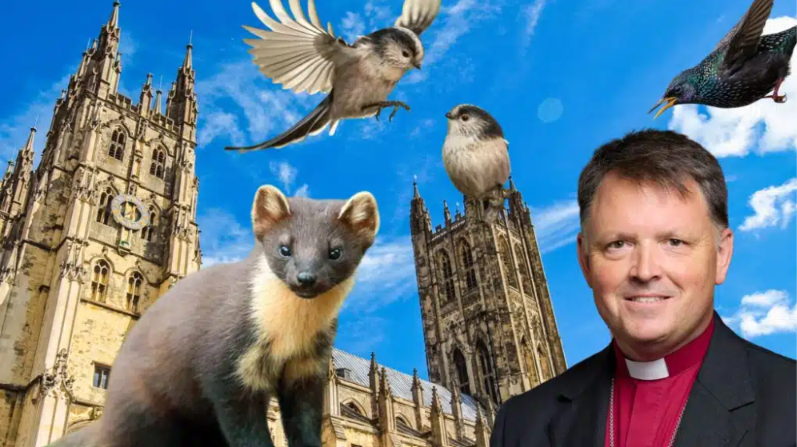
Instead, the Church’s General Synod rejected the proposal and approved an alternative amendment put forward by the Bishop for the Environment, the Right Rev Graham Usher.
The amendment includes commitments to support nature restoration where appropriate and to engage with tenants about sustainable farming—but contains no measurable target for rewilding or nature restoration.
Without clear targets, it becomes difficult to know whether sufficient progress is being made.
Campaigners at Wild Card, which is calling on the UK’s biggest landowners to rewild their land, expressed deep disappointment.
At a time when wildlife is declining across the countryside, they argued, the Church has missed an opportunity to demonstrate moral leadership.
The Vegan Organic Network shares this concern.
Land ownership brings responsibility
The Church Commissioners have argued that they must balance environmental objectives with their legal and fiduciary responsibilities. They point out that around 90% of their farmland portfolio is productive or highly productive agricultural land.
They say their approach is to integrate nature recovery into working landscapes while continuing to support food production and rural businesses.
But protecting nature and producing food should not be treated as opposing objectives.
The way we farm matters.
There is enormous potential to combine food production with biodiversity restoration through agroforestry, orchards, market gardens, diverse crop rotations, hedgerows, ponds, wetlands, wildflower areas and wildlife corridors.
And where land is unsuitable or unnecessary for intensive food production, allowing nature to return can provide even greater benefits for wildlife, soils, water and climate resilience.
The Church has the land, resources and influence to demonstrate what this could look like.
The Church should move away from animal agriculture
There is another important question that the Church of England should be asking: what is its agricultural land being used to produce?
The detailed figures for individual Church holdings are not publicly available, so it is not possible to say exactly what proportion of Church farmland is used for livestock. However, its agricultural portfolio includes mixed farming, rotational cereal production and permanent or temporary grassland grazed by animals such as sheep and cattle.
This is significant because animal agriculture requires substantial amounts of land—not only for grazing but also, directly or indirectly, for growing animal feed.
That land could instead be used to grow food directly for people, restore habitats, establish agroforestry and orchards, create woodland and wetlands, or allow nature to recover.
The Church Commissioners have emphasised that their farmland is highly productive. But what we choose to produce on productive land matters just as much as whether the land is productive.
The Church should therefore consider setting targets not only for nature restoration, but also for reducing its dependence on animal agriculture and increasing plant-based food production.
A future beyond animal agriculture
Vegan organic, or veganic, farming offers a practical model for producing food without farmed animals and without animal-derived fertilisers such as manure, blood, fish and bone.
Instead, soil fertility is built through plant-based composts, green manures, mulches, crop rotations and diverse planting.
This approach can combine food production with biodiversity and healthy soils.
Land currently used for livestock grazing could, where appropriate, be transformed into a mixture of plant-based food production, agroforestry, orchards, woodland and habitat restoration.
Crops currently grown to feed animals could increasingly be grown for people.
This does not have to mean abandoning farmers. The Church Commissioners could work with their tenants to support a just transition, helping farmers develop diverse, resilient forms of plant-based and vegan organic production.
Such a transition could reduce dependence on animal agriculture while creating opportunities for farmers to produce food directly for people and restore the natural systems on which agriculture ultimately depends.
3.5% is not enough
The scale of the opportunity is enormous.
The Church owns more than 100,000 acres of land, yet only around 3.5% is currently managed for nature restoration.
Other major landowners have shown that measurable commitments are possible. The Crown Estate, for example, has committed to managing 36% of its land for nature by 2030.
Meanwhile, only around 7% of land in England currently meets the criteria for the Government’s 30by30 target.
The biodiversity crisis demands much more than vague aspirations.
3.5% is nowhere near enough.
A moral responsibility
The Church of England has an opportunity to put its values into practice.
Caring for creation should mean more than protecting small areas of land for wildlife while continuing business as usual elsewhere. It should mean asking fundamental questions about how land is managed, what food is produced and what kind of countryside we want future generations to inherit.
The Church could become a major force for positive change by committing to measurable nature restoration, moving suitable land away from animal agriculture and supporting a transition towards plant-based, vegan organic farming.
It could demonstrate that producing food, restoring nature and caring for creation can go hand in hand.
The Vegan Organic Network believes that the future of farming should be about healthy food, healthy soil, abundant wildlife and a countryside free from dependence on animal agriculture.
The Church of England has the land and the influence to lead by example.
It had an opportunity to make a bold commitment to nature.
Instead, it chose not to.
But the opportunity remains. The Church can still choose to use its landholdings to create a healthier, greener and more compassionate future—for people, animals, soil and the planet.