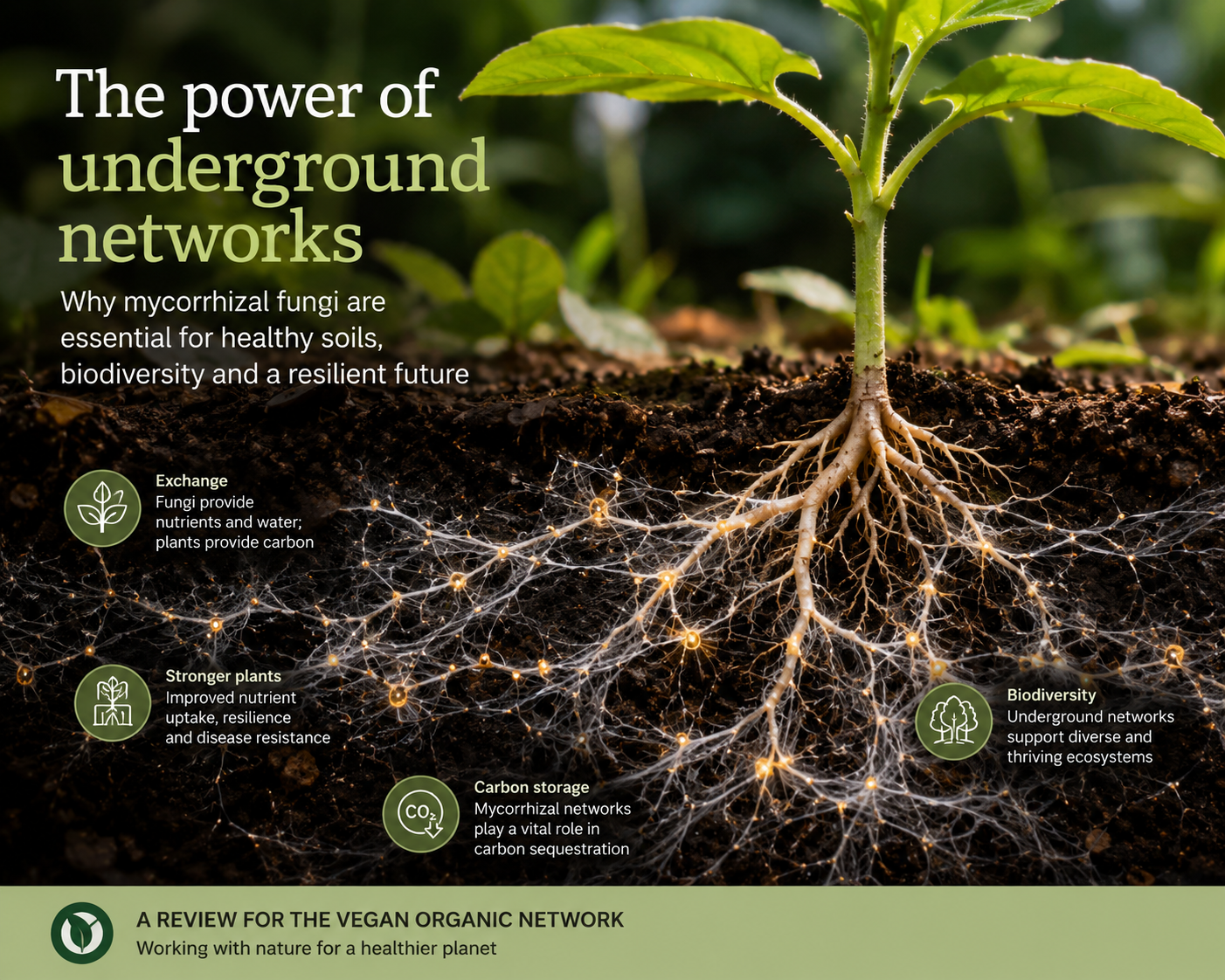
Catherine Early’s compelling profile of Toby Kiers shines a light on the extraordinary world beneath our feet, revealing how mycorrhizal fungi form vast underground networks that sustain ecosystems, regulate carbon flows, and support plant health. The article is both scientifically informative and deeply relevant to those interested in ecological restoration, climate resilience, and sustainable agriculture.
For members of the Vegan Organic Network, the piece reinforces a fundamental principle of stockfree organic growing: healthy soils are living systems whose fertility depends on complex biological relationships rather than external chemical inputs. Kiers’ research demonstrates that mycorrhizal fungi are not passive soil organisms but active partners in plant growth, exchanging nutrients and water for carbon in a sophisticated mutualistic relationship that has evolved over hundreds of millions of years.
Particularly striking is the article’s discussion of how modern agricultural practices can disrupt these relationships. The widespread use of synthetic fertilisers and fungicides weakens the natural partnership between plants and fungi, reducing the carbon plants supply to their fungal allies and potentially undermining soil structure and resilience. This observation echoes long-standing concerns within the vegan organic movement about the ecological costs of input-dependent farming systems.
The article also highlights the growing recognition that restoration projects must consider not only native plants but also the native fungal communities with which they co-evolved. This insight has profound implications for ecological restoration and regenerative land management. Restoring biodiversity above ground cannot succeed fully without rebuilding the biological networks below ground.
Kiers’ work through the Society for the Protection of Underground Networks (SPUN) is especially encouraging. By mapping fungal biodiversity and advocating for its inclusion in conservation policy, SPUN is helping to address a significant blind spot in environmental protection. The fact that 90 per cent of the world’s most diverse underground fungal systems currently lack protection should concern anyone interested in safeguarding biodiversity and ecosystem health.
Perhaps the article’s greatest achievement is its ability to shift our perspective. Rather than viewing soil as inert matter, it invites readers to see it as a dynamic, living community that underpins all terrestrial ecosystems. For vegan organic growers, this understanding reinforces the importance of nurturing soil biology through practices that enhance organic matter, minimise disturbance, and avoid synthetic chemicals.
The article is engagingly written and succeeds in making complex ecological science accessible to a broad audience. It serves as a powerful reminder that many of the solutions to today’s environmental challenges may already exist within nature’s own systems. As awareness of fungal networks continues to grow, their protection and restoration could become a cornerstone of sustainable agriculture and ecological recovery.
Overall, this is an inspiring and thought-provoking piece that aligns closely with the Vegan Organic Network’s commitment to working with natural systems to build healthy soils, resilient ecosystems, and a more sustainable future.
Source article: Catherine Early, The Ecologist, profile of Toby Kiers and the importance of mycorrhizal fungal networks.