
Iain Tolhurst MBE
The act of tillage is gathering a bad reputation within agriculture, the plough in particular is seen as the devil of the land, wrecking soil and displacing micro-organisms. In many respects this is often true now that we have enormous machines capable of dragging eight furrows to a depth of 30cm and more. But it’s not just the plou
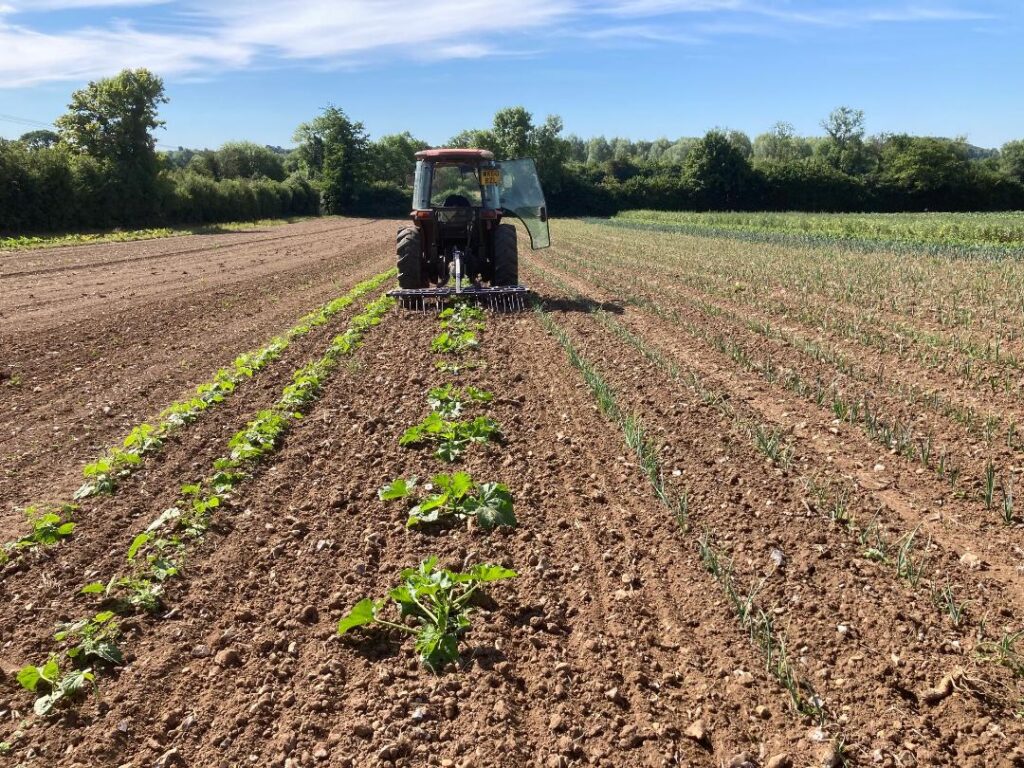
Harrow comb in squash
gh, it’s a combination of other damaging activities happening with soil management that is adding to the problem. When I say management it’s really more about mismanagement of the soil. Farmers or in many cases agricultural contractors, for it is now common for farmers to give up on soil management leaving the task to those with enough scale to be able to afford the increasingly large and expensive machines. The pressure is on for the contractors to get the job done and move onto the next farm before it rains and whilst the machines are still under guarantee. Soil management is a long way from their thoughts.
Agri-chemicals are further destroying soil life and depleting the most noble of all soil animals, the humble earthworm, that preserver of soil drainage and structure has on many farms been pushed to the brink of extinction. Once these have gone the soil goes into a downward spiral of degradation and extreme stress. Soil structure collapses and ever more cultivations are needed in an effort to create a degree of tilth for plants and seeds to establish. Clearly this is a catastrophe not just for soil but for the whole of biodiversity and indeed the need to safeguard a sustainable food system for feeding people. Farmers are becoming increasingly aware of the negative effects poor soil management is having on the basis of all life on Earth. They are also acutely aware of the financial cost of this damage if created on their own farms. So, min-till or in some cases no-till was born. The latter is only appropriate for vegetable growers who in some cases are prepared to import large amounts of bulky organic materials to support intensive crop production. I will cover this somewhat controversial system in a future article.
Minimum tillage
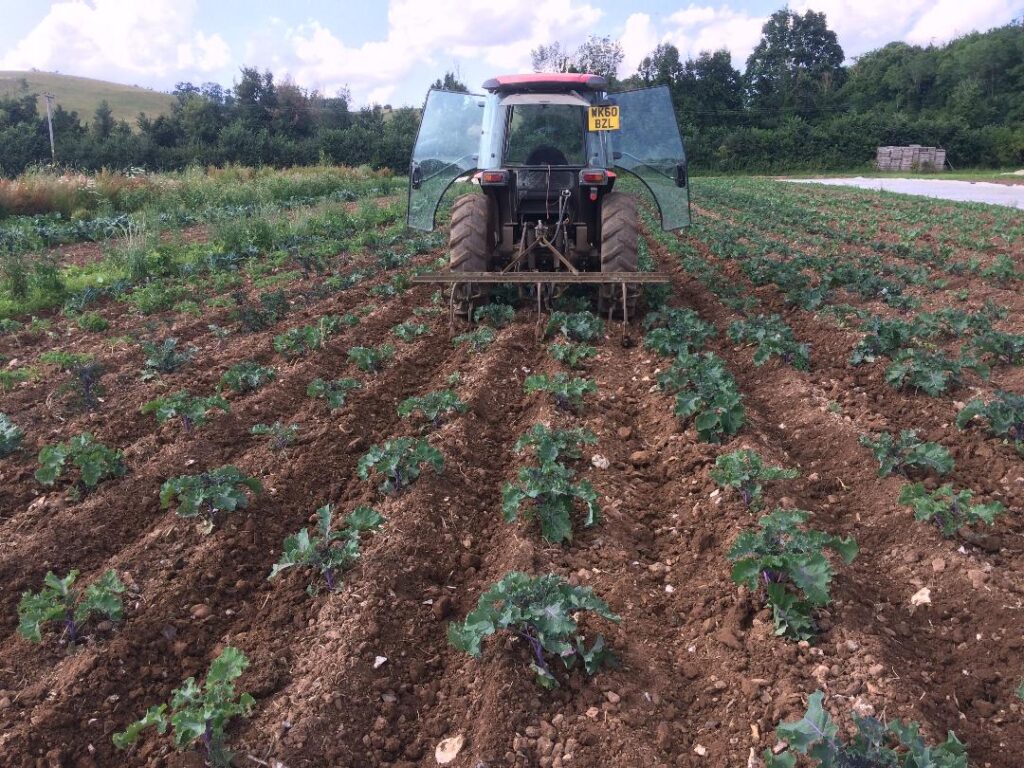
Ridging kalettes
Min-till has distinct advantages over conventional plough-based tillage systems.
- Reduced time with faster operations.
- Less passes.
- Less fuel used.
- Less soil damage.
- Less soil life disruption.
- Less loss of carbon.
- In some cases, a small improvement in carbon levels.
Looks like a less input system, and indeed it is but as with any system it does have its negative side too, the main one being weed problems, especially perennial ones, and on some soil types, a problem of compaction within the top 100-200 cm of soil. Conventional agriculture is totally hooked on Roundup for weed control and for many to contemplate removing this chemical would mean the death of the no-till system on their farm. The improvement in carbon levels is for most farms a significant step forward. However, it may not be as great as it would first appear. The carbon is close to the soil surface and extremely vulnerable to loss through environmental degradation or untimely cultivations and extended bare soils. Soil compaction is a big issue with some soil types, and it is inevitable that the farm will resort to pulling the plough out of the nettles and having to deploy it in order to get some structure back into the soil, done occasionally this is perfectly legitimate, but shallow plough only. Drainage is often impaired on compacted soil, and this is due almost exclusively to a reduced earthworm population, evidence is mounting that Roundup will seriously reduce earthworm growth rates.
Organic min-till
So how does min-till fit into an organic system, where farmers are supposedly more aware of soil health and appropriate tillage? This may not always be the case and in horticulture particularly some bad practices are seen to be in place. For organic systems one of the main reasons for tillage is in order to control weeds, especially annual ones. Gentle surface cultivation in the form of stale seedbeds is a standard practice on many vegetable farms and has only minor negative soil damage. This may well be considered min-till, but this begs the question as to how do we get land prepared from say a heavy crop of green manure going into sowing or planting vegetables without the use of a plough?
Methods

Ransoms 3 furrow plough. Ideal for shallow work
For organic cereal farmers min-till techniques can offer more options for land preparation with min-till cultivators such as the Eco Dyn. This tool has been widely studied by Organic Research Centre and initial trials showed very favourable results with reduced fuel and labour costs. And comparable or better (to ploughing) cereal yields. However, after several seasons problems arose with a heavy burden of perennial weeds and some degree of compaction. It became clear that the plough would be needed every few seasons to remove the compaction and deal with some of the weed burden. For vegetable growers the Eco Dyn is very expensive and could only be considered for very large acreages. Other min-till tools are available and may offer more cost-effective alternatives. With heavy cover crops in place through the rotation often the best result and most expedient approach is to flail mow the green manure and shallow plough to 10-12cm followed by a single pass with a power harrow. Perhaps not consider min-till but more “reduced-till”. This tillage will enable you to get a crop in almost straight away, if it’s a direct drilled one you may need to wait 2-3 weeks for the green manure to break down or it may inhibit seed germination. This will enable a weed strike prior to drilling.
The production of vegetables makes heavy demands on the soil and there are inevitably many passes with equipment from primary tillage through to final harvest; there could be 4-8 separate machinery passes. Even with reduced-till this is a lot of potential soil damage so we need to keep this to the minimum. Design of the rotation is a key to preserving soil health and structure, allowing periods of soil rejuvenation where no tillage at all exists for several seasons, and regular green manures will go a long way to preserving soil health.
The plough is not the demon of soil health-it’s not the plough it’s the how! We plough three times within our seven-year rotation and have been doing so for 40 years in the same fields where carbon has increased slightly and soil bulk density is lower than the grassland that we started with, so we know that a tillage system can bring positive soil health if done with care. Keeping living roots in the soil is the key to achieving this.
Top tips
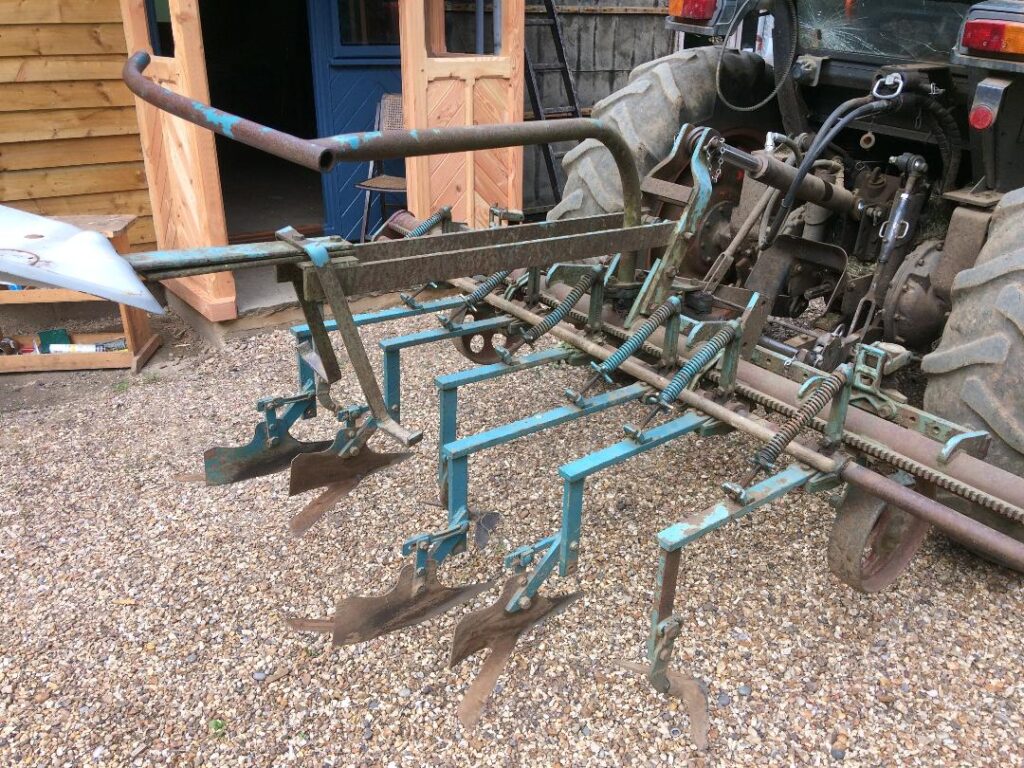
Steerage hoe set for 2 rows
As to the actual tillage techniques there are some basic rules that must be followed:
- Keep it as shallow as possible so if any loss of structure comes about it is easy to deal with.
- Never plough in compost/manure more than 10-12 cm, same applies to green manures.
- Avoid any tillage when soil is too wet, too dry or frozen, on some soils the window of opportunity may be quite short. Yes, I know how frustrating having to wait is but get it wrong and you mess the soil structure, you will pay for this over the next many seasons.
- Tractor driven rotovators are the most damaging of any tool, never use it as a primary tillage tool and never go deeper than 5cm. Its only sensible use is chopping up green manures/crop residues on the surface prior to primary tillage.
- Subsoiling should never be necessary if you have deep rooting green manures (such as chicory and lucerne) and you are careful with tillage operations. Subsoiling may be needed on land that has a severe hard pan problem. Use vertical leg with winged shares and only when soil moisture is low, this is usually in the autumn. Follow with a deep rooting green manure.
- Avoid any act of tillage that promotes shear and smear of the soil. The rotovator is especially bad at this. Power harrow knife tines are more damaging than round points.
- For bastard fallow techniques the spring tine is the ideal tool, cheap, fast and effective with little soil damage. Several passes in dryish conditions will achieve good control of most weeds except thistle.
- For inter row work steerage hoes are very good as well as various tined implements set up for row work, sweeping soil into the row to smother weeds between plants.
- Consider ridging systems for row crops, all crops will benefit from some ridging up and weed control can be much more effective.
- Keep as much green manure in place as possible especially over the winter period. Learn how to relay green manures into growing crops. Rotation is key to this.
- Use the smallest/lightest tractor that will do the job, 4WD is essential, best of all is crawler tracks but not great for row work. On our 17 acres we use a Kubota 59hp 4WD for primary and secondary work as well as row work. It is light and nimble.
- Tool carriers such as the Bean or Fendt are excellent for row work but hard to come by. They are light and offer great visibility for a range of between row operations.
- Keep to the minimum number of tillage passes needed to achieve the desired effect. Every time you cultivate, no matter how gentle, you are doing some soil damage.
- Make sure that if you do inadvertently damage the soil that you repair it at the earliest opportunity, this will almost definitely mean a green manure of some type.
Much work needs to be done to explore the possibilities with min-till in organic vegetable systems. Crimping of green manures and sowing direct is fairly common in the USA with cereal rotations but is dependent on the crop and some fairly expensive large-scale machinery not available to vegetable producers. Smaller scale equipment is needed specifically for vegetables.
So, min-till is presently an ideal dream but one that definitely needs to be brought forward onto farms. In the meantime, we must develop our systems to reduce tillage and be aware of soil problems and how to reduce and eliminate them from our farms. Soil health needs to be the driver of our farming systems.
Iain Tolhurst MBE
October 2024