Iain Tolhurst

Beetle banks on agricultural holdings have been around since the 80’s. Primarily the preserve of large scale cereal growers, they have recently become more common on such farms, since the agri-payments have favoured their presence.
It is unfortunate that they are so rare on organic holdings especially those that grow vegetables. Growers
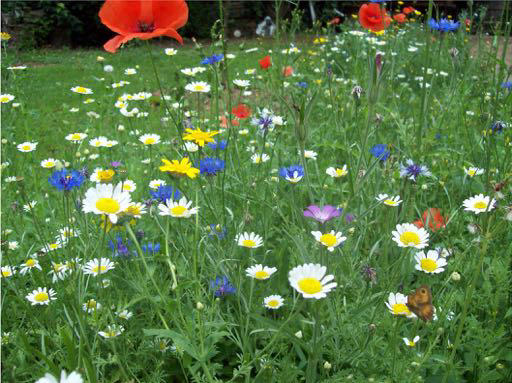
tend to be wary of the complication factor and the perceived loss of cropping space. This is a pity, as the use of beetle banks can pay handsomely in pest control, adding significantly to wildlife populations and can look extremely attractive. We have been using them at Hardwick for almost 25 years and have seen the number of wildlife species grow steadily over that time, especially birdlife, which serves as a great indicator of increased biodiversity.
We have them placed strategically at the junction of the rotation plots serving to mark the boundaries of the areas and ensure no overlap of same-family groups. In general they are 2m wide and the length of the rows across the field typically around 150m. For our rotational plots of 0.7 ha each this puts them at around 50 metres apart. This is an ideal distance as it allow the beneficial insects to move out to the crops when they are needed. They are also situated at some field margins. These are very well populated with diversity as they have a direct link to the hedges and trees. Beetle banks are able to connect your cropping area directly to hedges and any wild area surrounding your field and have the effect of creating smaller field sizes without the disadvantage of reducing your working area. The loss of land allowing for the 2m of beetle bank and a weed free strip each side amounts to less than 10% of cropped area. I consider this a price well worth paying, due to the reduced pest problems we have encountered. There is an additional benefit in that beetle banks accumulate a large reserve of permanent carbon that will offset some of your carbon footprint.

There are two ways to establish them:
- Do nothing apart from leaving a strip of land uncultivated and see what grows. Initially this may look like a weedy strip of bad husbandry but give it a year or two and you may be surprised at what materialises. A lot depends on your soil’s inherent weed seed bank, as in time some of the annual weeds will disappear, as more resilient perennial plants become established along with some annuals that need the presence of the taller species. After several seasons the strip will reach a natural equilibrium and become rich with floral diversity. Our land is calcareous and contains a broad spectrum of flora. This may not be the case on heavier more acidic soils. The chances are that if your land has been under intense cultivation for a long period of time you will have lost a lot of the natural seed bank so option 1 may not be effective.
- Sow a specific mix of wild flowers and grasses. These must be of indigenous types, so to see what you should be growing, find out more about the natural flora of your soil type and area. Wild flower books are good for ideas. I have tried using a Cotswold Seeds mix suitable for my soil type containing around 20 different species, however I have never been able to identify more than around 10 survivors so clearly some are not suitable. Do not include strong growing legumes as they will over shadow the annuals unless in very small proportions. Dwarf white clover is suitable.