VON at The Martin’s Act Bicentenary Anniversary Conference 2022
Hello readers, I’m Michelle St John, the founder of an educational initiative called VinE, Veganism in Education. We produce and recommend learning materials for teachers concerned with encouraging empathy, good health and sustainable choice-making in their students. We recently partnered with VON in order to support each other’s work and explore opportunities for collaborative projects.
My personal experience of the Vegan Organic Network goes further back in time, and living near Manchester, I’ve been fortunate to attend many of their fantastic events.
THE EARLY YEARS!
I particularly recall a VON fair held in the grounds of a venue in Chorlton. It was a beautiful sunny day and the place was ‘buzzing’. It was especially memorable because it was the first vegan fair my family and I had ever attended; we thought we’d entered heaven! New to veganism, it was wonderful to feel welcomed into a wider like-minded community. The joy and pride we experienced in just attending, made us giddy with excitement!
Needless to say, we gorged ourselves on all the delicious food and purchased an insane amount of vegan goodies, including a copious number of T-shirts which we still wear today! This event set our benchmark standard for vegan fairs and festivals; it remains unsurpassed!
JANUARY 2022
Several years on, the stars aligned once more, and VON appeared at another key moment in my vegan journey. Having just launched VinE, MAD Ideas (a VON Sponsor and VinE Ambassador) told me about VON’s ‘Save Our Wildlife’ competition. I’m forever grateful to them for informing me about this competition, and linking our organisations together.
VON was the first organisation to feature on the VinE website. Their wonderful video of competition entries, demonstrated how a vegan organisation could help educate children and young people about animal rights and related health, social justice and environmental issues, in a creative and impactful way.
JULY 2022
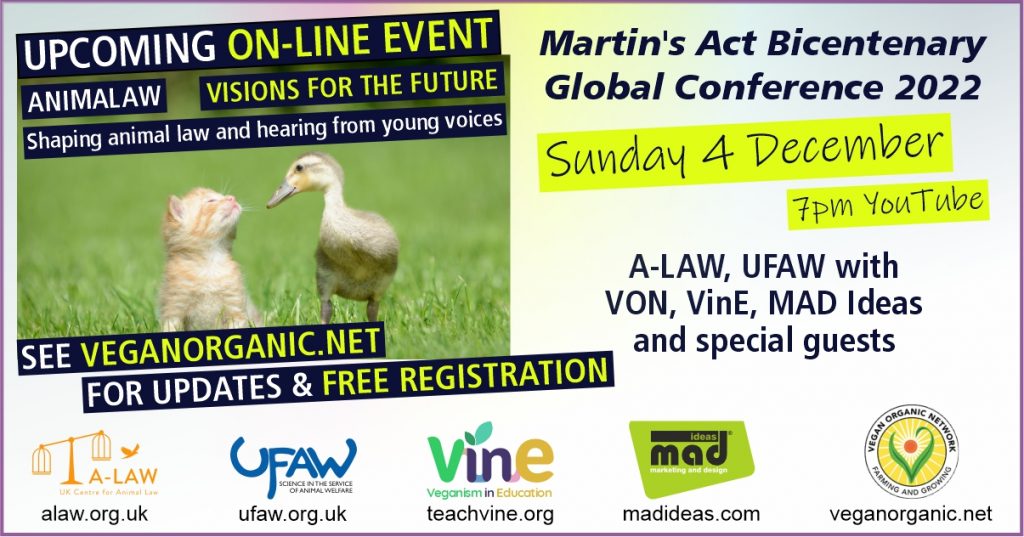
In July, an opportunity arose to share VON’s ‘Save Our Wildlife’ competition with a global audience attending a joint UK Centre for Animal Law (A-LAW) and Universities for Animal Welfare (UFAW) conference, celebrating the bicentenary of the ‘Martin’s Act’. This was Britain’s first legislation protecting animals from deliberate acts of cruelty.
Parliament passed the Cruel Treatment of Cattle Act in 1822. The statute became known as the ‘Martin’s Act’ after its sponsor, the MP and animal rights campaigner Richard Martin. While it only protected a limited number of species from certain types of abuse, it was the first time that legislation had been passed with the interest of animals at its’ heart.
WHO WAS RICHARD MARTIN?
At this point, I think it’s worth delving a little deeper into the Act and the great man behind it. If time travel existed and I had the chance to meet revered figures from the past, Richard Martin would feature high on my list!
Born in Galway in 1754, he was a spirited defender of the poor and animals. Indeed, such was his compassion for his fellow creatures, even King George IV dubbed him ‘Humanity Dick.’
While this progressive Act made it illegal to harm certain animals, it also stipulated it was up to private citizens to bring charges of cruelty before the magistrates. As with most legislation, the real challenge for its efficacy lay in its enforcement.
Never one to shy away from fighting for the rights of animals, Martin mounted a prosecution against Bill Burns, a London hawker of fruit and vegetables, who had been caught beating his donkey.
Deploying unusual tactics, Martin took the extraordinary decision to lead the donkey into the courtroom so that the injuries and its’ state of neglect could be seen. So severe were the injuries, the magistrate found Burns guilty, making him the first person to be convicted of animal cruelty. The famous painting by P Mathews depicts the courtroom scene.
In 1824, two years after the Act was passed, in a coffee house on St Martins Lane in London, a group of men met with the idea of forming a society concerned with enforcing the Martin’s Act and heightening awareness of animal welfare. The group included Richard Martin, Reverend Arthur Broome and William Wilberforce. This society was initially named the Society for the Prevention of Cruelty to Animals (SPCA), later receiving royal assent from Queen Victoria, making it the RSPCA.
BACK TO THE CONFERENCE!
The conference marking this bicentenary anniversary would feature leading scientists, lawyers and advocates sharing their visions for the future of animal law. A series of talks would be given over five days (18th – 22nd July), with each day focused on a different area of interest. The last day would feature presentations on education policy, with the final slot reserved for children and young people’s visions of a better future for animals.
As a former barrister and member of A-LAW, I was approached by their chairperson, Paula Sparks. She noticed I’d set up an educational initiative, and wondered if I had any ideas for the young people’s programme as they had nothing scheduled? I immediately thought of VON’s ‘Save Our Wildlife’ competition and forwarded their video of exhibits. Paula thought it was fantastic! VON’s contribution became the foundation on which we built the hour long ‘Young Voices’ programme.
Dan Graham did us proud! His introduction to VON and the competition was really engaging and professional. Both VinE and the conference organisers are thankful to everyone at VON for helping make this section of the conference such a success. The positive feedback we’ve received has been tremendous!
VinE is looking forward to working on future educational projects with VON. Researching opportunities for the greater inclusion of vegan organic growing initiatives in schools is an exciting prospect.